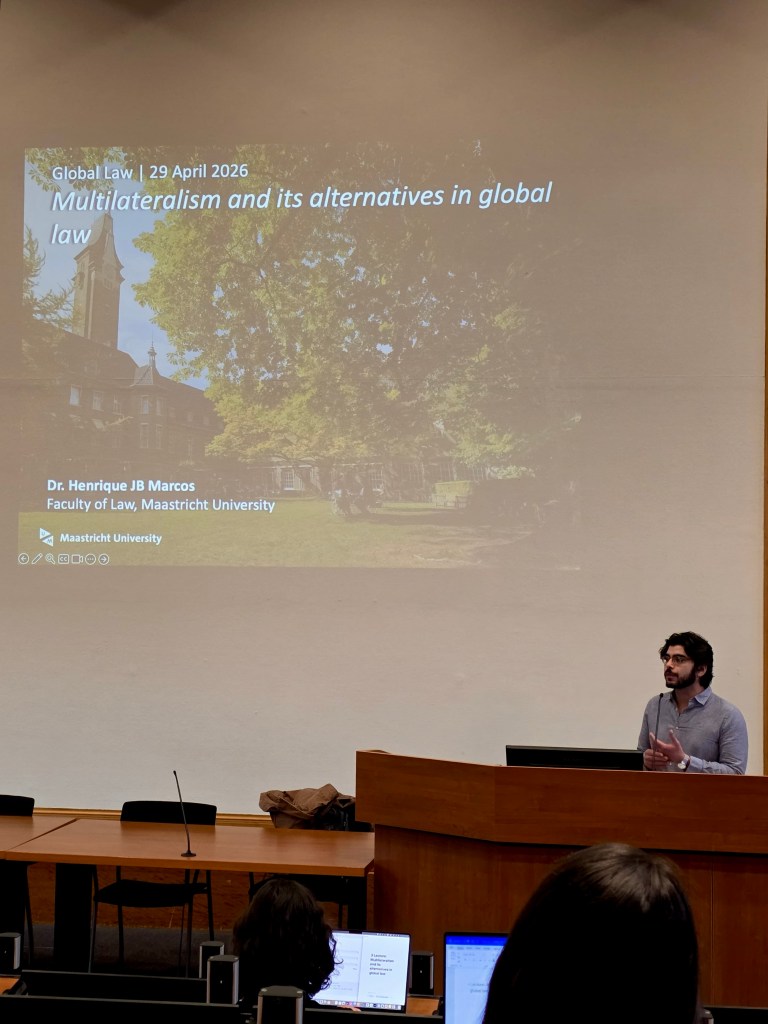
Last Tuesday I gave a lecture on multilateralism for our Global Law master’s course at Maastricht. For the early 8:30am slot I wanted something engaging rather than a slide deck read aloud, so I built it as a guided tour through five rooms where global governance actually happens…
🏛️ Room 1 — the Grand Hall: formal multilateralism (WTO, UN, UNFCCC). The room with the strongest claim to legal authority and, right now, the weakest capacity to deliver. Two exhibits: the WTO Appellate Body, paralysed since December 2019, and the Security Council, paralysed by veto on every conflict that matters most.
🥂 Room 2 — the Club Lounge: minilateralism. Smaller coalitions, faster decisions, narrower membership. Falkner’s input/output legitimacy distinction was the workhorse here.
✍️ Room 3 — the Regulator’s Office: extraterritorial unilateralism. Think of the Brussels Effects → authority through market power rather than consent.
🗺️ Room 4 — the Regional Corridor: plurilateral and regional arrangements. Morse and Keohane’s regime shifting and competitive regime creation.
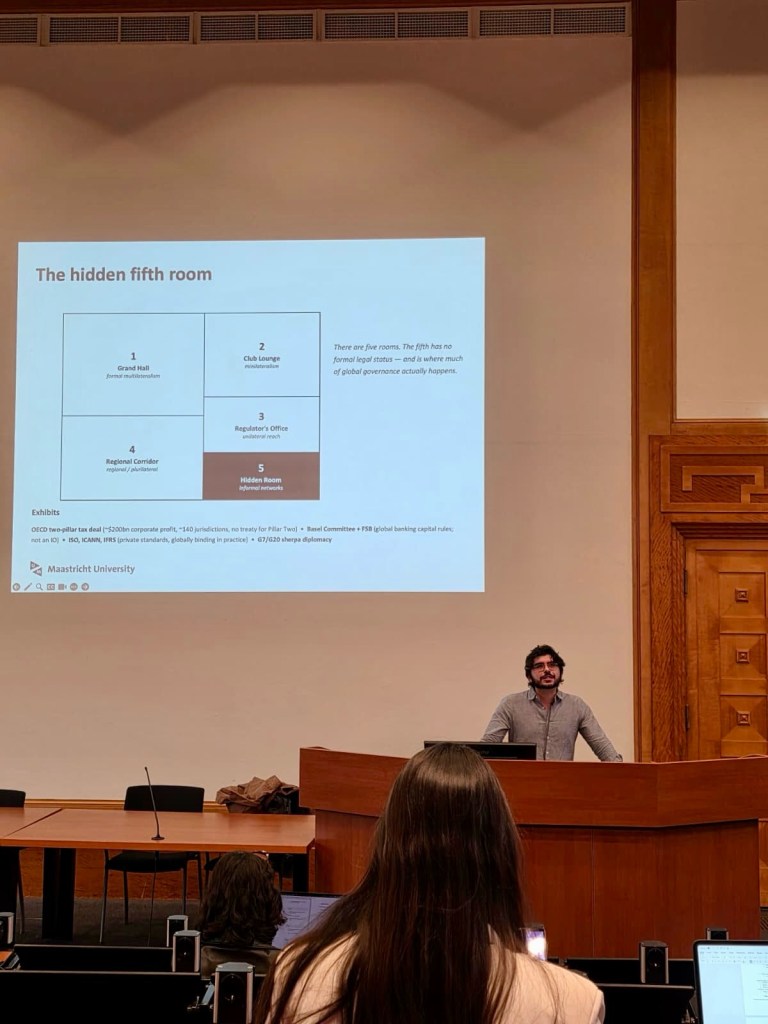
Then, at the end, the grand reveal: there is a fifth room!!!
🚪 Room 5 — Informal coalitions, private standard-setters, transnational regulatory networks. There is no formal legal status, and where a startling amount of global governance actually happens.
The hope was that students would leave with a spatial framework they could carry onward and a feel for global law as it actually happens in international practice
Thanks to the course coordinator, Dr Sebastian Reyes Molina, and the student cohort for being a sharp and engaged audience at an early hour.

