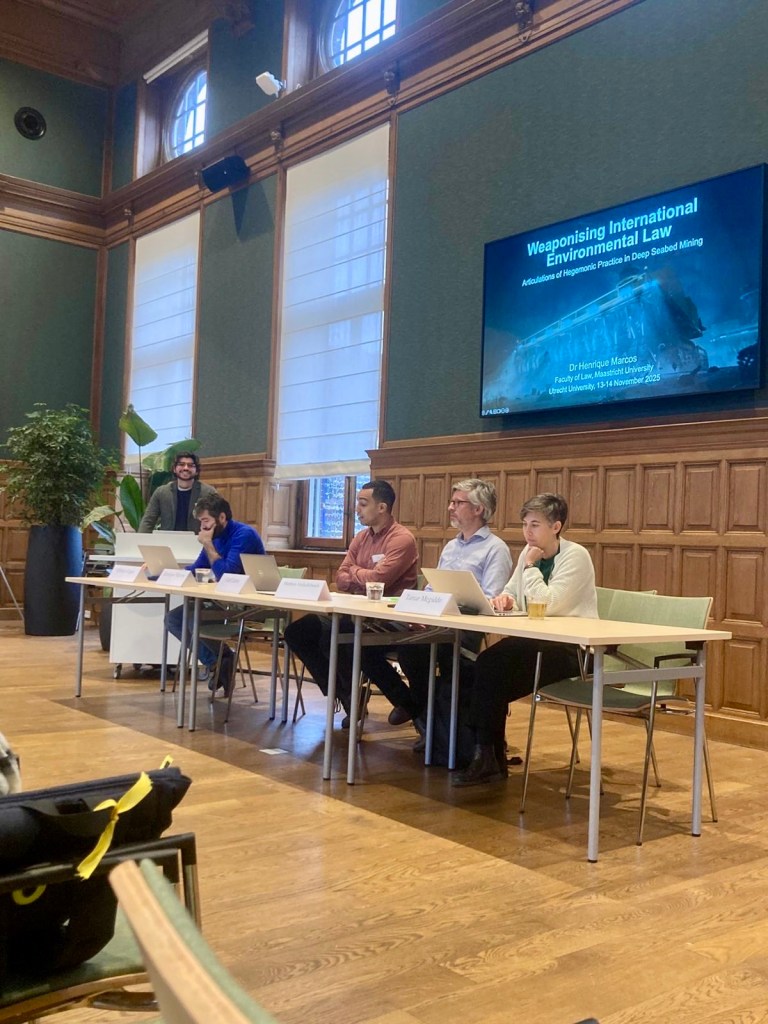
On 13–14 November 2025, I presented the paper “Weaponising International Environmental Law: Articulations of Hegemonic Practice in Deep Seabed Mining” at the Sixth Workshop on Sociological Inquiries into International Law in a Polarized World: Markets, National Security, and Democracy, held at the Johanna Hudig Gebouw, Utrecht University School of Law.
The paper examines how “environmental protection” functions as an empty signifier in deep seabed mining governance — a term that all parties claim to champion, yet fill with radically different meanings depending on their strategic interests. Drawing on the discourse theory of Laclau and Mouffe and neo-Gramscian international political economy (particularly Robert Cox’s work), I argue that the US, China, and Pacific Island States are not simply interpreting environmental law differently, but are engaged in competing hegemonic articulations that link “environmental protection” to distinct chains of equivalence serving their material and geopolitical goals.
The analysis traces how the United States dramatically shifted its position after the April 2025 Trump Executive Order on critical minerals, rearticulating “environmental protection” from precaution to energy independence overnight. It examines how China leverages its five ISA exploration contracts and technical standard-setting to position itself as defender of the multilateral framework, and how Pacific Island States articulate environmental protection through indigenous knowledge and ocean stewardship — yet remain fractured between those sponsoring mining and those demanding a moratorium.
A key contribution is showing how the International Seabed Authority operates not as a neutral arena but as a hegemonic apparatus — an institution whose procedural structures systematically privilege certain actors while appearing fair. The paper also introduces the concept of environmental lawfare: the strategic deployment of environmental legal arguments as instruments of geopolitical competition.
Many thanks to the organisers — Alexandra Hofer, Birte Böök, and Luca Pasquet (Utrecht University School of Law), Sungjoon Cho (Chicago-Kent College of Law), Moshe Hirsch (Hebrew University of Jerusalem), Ron Levi (University of Toronto), and Mikael Rask Madsen (iCourts, University of Copenhagen) — for a wonderfully rich and thought-provoking workshop. The event was organised by RENFORCE in cooperation with the Utrecht University Research Platform on Peace, Security and Human Rights, UCALL, and the Netherlands Institute of Human Rights (SIM).
 Henrique Marcos