

AI and Marine Environmental Policy
What role for automated systems?
The research question
Bioprospecting — the search for commercially or scientifically valuable compounds in living organisms — has historically depended on physical access to genetic material. Researchers sailed to collection sites, gathered samples, and tested them in laboratories. International law was designed around this model: legal obligations are triggered by physical access to a geographic location.
Artificial intelligence changes this. Researchers can now download genetic sequence data from public databases, use machine learning tools to predict molecular structures, and identify promising compounds computationally — without ever collecting a physical sample. When discovery no longer requires physical access, the legal rules designed to govern that access may no longer apply.
This project investigates what happens to international environmental law when the activity it regulates becomes invisible to its own instruments.
Two structural problems
The project focuses on two gaps that existing governance frameworks have not addressed.
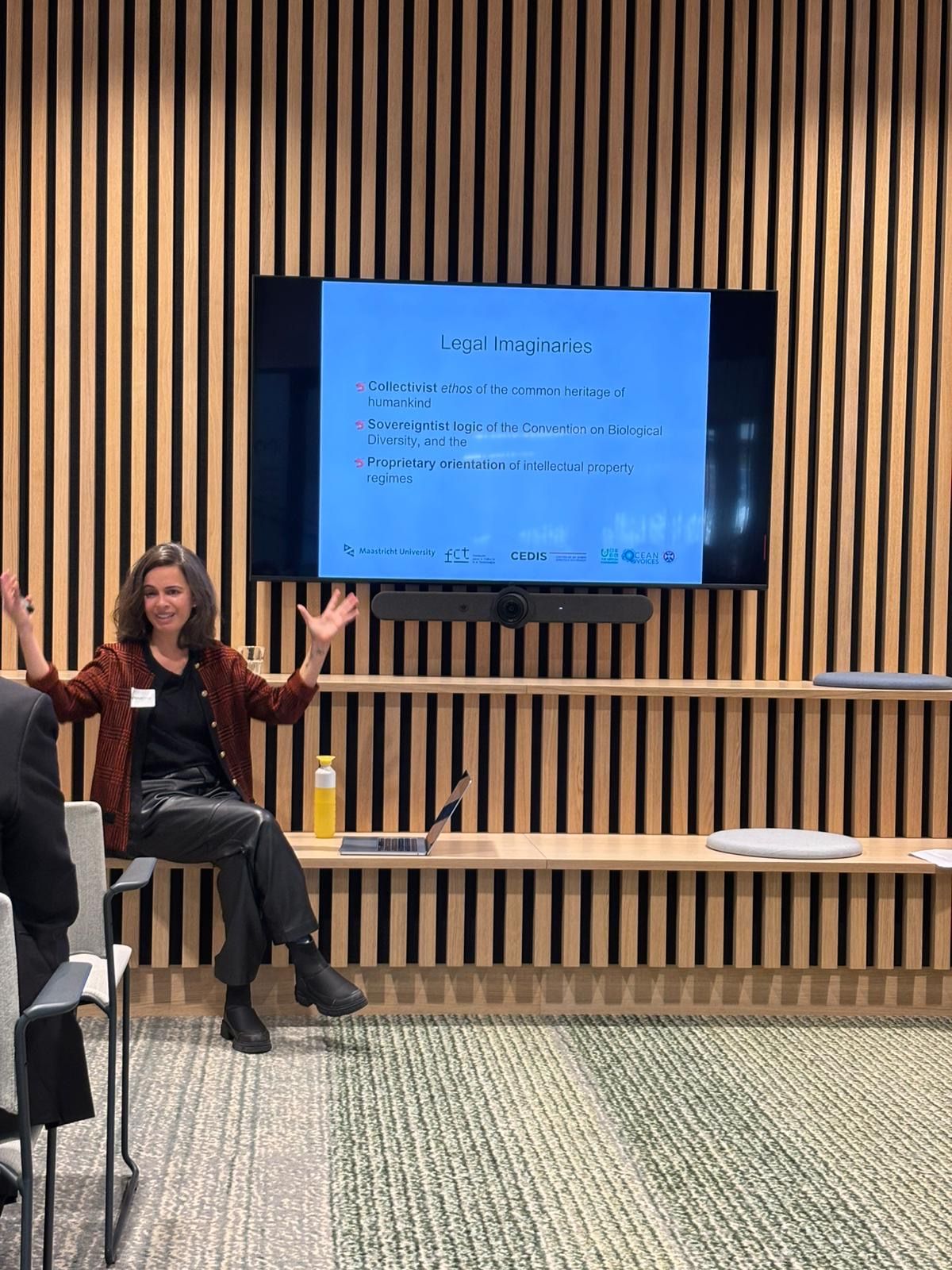
The gap between dematerialisation and opacity. The biodiversity governance community has studied the shift from physical samples to digital sequence information — what scholars call dematerialisation. But AI introduces a further step: from digital data to computational prediction. This is opacity. The governance tools designed for dematerialisation cannot reach opacity, because the computational process that produces the output is structurally different from the digital data that feeds it.
The gap between explainability and attributability. The AI governance community has focused on whether we can understand how a model works — explainability. But bioprospecting AI raises a different question: can we trace which inputs produced a given output — attributability. A fully explainable model can still be fully unattributable. The legal frameworks that address explainability (including the EU AI Act) do not solve the attributability problem.
Mapping legal positions across treaties
The project examines how six international instruments interact — and where they fail — when bioprospecting becomes computational: BBNJ Agreement (2023) · Convention on Biological Diversity (1992) · Nagoya Protocol (2010) · TRIPS Agreement (1994) · WIPO GRATK Treaty (2024) · UNCLOS (1982).
A core output of this project is a series of Hohfeldian mappings that visualise the legal positions (rights, duties, powers, immunities) created by each instrument. These mappings reveal where obligations overlap, where they conflict, and where AI-driven bioprospecting falls through the gaps.
Selected publications
Marcos, H., et al. ‘Marine Genetic Resources, Who Owns and Who Owes What? A Hohfeldian Mapping of Legal Positions on MGRs‘ — Leiden Journal of International Law (forthcoming 2026).
Deep Ocean Stewardship Initiative (2025), ‘Towards Coherence and Avoiding Undermining: Policy Recommendations on Implementation of the BBNJ Agreement Regarding Marine Genetic Resources‘ — Policy Brief.
Nanda, R., Marcos, H., Westermann, H. & Schutz Veiga, J. (2025), ‘A Hohfeldian Knowledge Base for LLM-Assisted Legal Information Retrieval in Marine Biodiversity Law‘ — In: Markovich, R. et al. (Eds.), Legal Knowledge and Information Systems (Vol. 416, pp. 318–323, IOS Press).
From research to the classroom
This project informs ‘Coding Nature: Law and Ethics in the Age of Algorithmic Bioprospecting,’ a Legal Challenge course at Maastricht University’s European Law School in which students investigate how international environmental law should respond to AI-driven bioprospecting.
This project is funded by the Empirical Legal Studies (ELS) Academy, Leiden University. Principal Investigator: Dr Henrique Marcos, Faculty of Law, Maastricht University.

 Henrique Marcos